
Which Brother TZe Label Tape Do You Need? An Australian Size and Compatibility Guide

Picking the right Brother TZe label tape means matching your P-Touch hardware to where the label will actually be used. Genuine TZe cassettes use a specialised sub-lamination process that shields text from friction, industrial chemicals, and harsh outdoor exposure. Choosing the wrong width or substrate can lead to cable flagging, faded print, or labels that don't hold up to compliance audits.
This guide is fact-checked directly against Brother's own Australian resources: the official TZe label tape overview, the TZe durability test data sheet (PDF), and the official TZe tape catalogue (PDF).
Quick Reference: Choosing the Right TZe Tape
Brother's TZe range is large, and the right choice comes down to balancing your printhead's width limit with where the label will be used. The table below maps genuine cassettes to common Australian applications.
| Tape Width Format | Specific Material Class | Targeted Australian Real-World Use Case | Core Part Number Prefix | Technical Field Note |
|---|---|---|---|---|
| 3.5mm / 6mm | Standard Laminated | Slim asset tags, slimline patch panel bays, internal circuit breakers. | TZe-111, TZe-211, TZe-611 | Ideal for fine micro-text requirements on space-constrained equipment. |
| 9mm / 12mm | Flexible ID (Laminated) | Cat6/Fiber data line wraps, tightly curved pipework, small conduit systems. | TZe-FX221, TZe-FX631 | Eliminates long-term "flagging" and edge lift. Brother's own peel testing shows Flexible ID and Self-Laminating tape are the only TZe families rated for reliable adhesion down to a 3mm cable diameter; standard and strong adhesive tape peeled or detached at that size. |
| 12mm | Iron-On Fabric (Non-Lam) | School uniforms, trade hats, canvas gear, corporate work vests. | TZe-FA3, TZe-FA63 | Withstands intense industrial laundry temperatures. |
| 18mm / 24mm | Strong Adhesive | Powder-coated server enclosures, warning decals on distribution boards. | TZe-S241, TZe-S651 | Brother's own JIS Z 0237 lab testing shows up to roughly 3x higher adhesive force than standard tape on textured/industrial surfaces (materials like polyamide and PET showed the largest gains). |
| 21mm / 31mm | Heat-Shrink Tube (HSe) | Electrical core insulation, permanent heavy-gauge wire markings. | HSe-251E, HSe-661E | 3:1 physical reduction ratio upon thermal activation. HSe-251E (21mm) fits cable diameters roughly 4.2–13.5mm after shrinking; HSe-261E (31mm) fits roughly 6.3–20mm. |
| 18mm / 24mm | Tamper Evident (Laminated) | High-value asset tracking, IT server housing seals, warranty verification. | TZe-SE4 (18mm), TZe-SE5 (24mm) | Leaves a permanent "checkerboard" pattern if voided. Brother recommends leaving security labels affixed for at least 24 hours before they are relied on to function correctly. Tamper Evident cassettes are manufactured strictly in 18mm and 24mm widths. There is no 36mm version. |
Regulatory compliance context: In Australia, workplace health and safety practice calls for clear, durable asset marking. AS/NZS 3760 covers the inspection and testing regime for in-service electrical equipment (the framework behind routine "test-and-tag" programs), while AS/NZS 3000 (the Australian/New Zealand Wiring Rules) calls for clear identification of switchboards, protective devices, and isolation points. Neither standard mandates a specific label brand, but both rely on markings that stay legible for the life of the equipment. That's typically where unlaminated generic tape fails first, through ink degradation or adhesive lift under service conditions. Always check the current published standard for your specific compliance obligations.
Why Genuine TZe Survives the Australian Elements
How the Lamination Sandwich Is Built
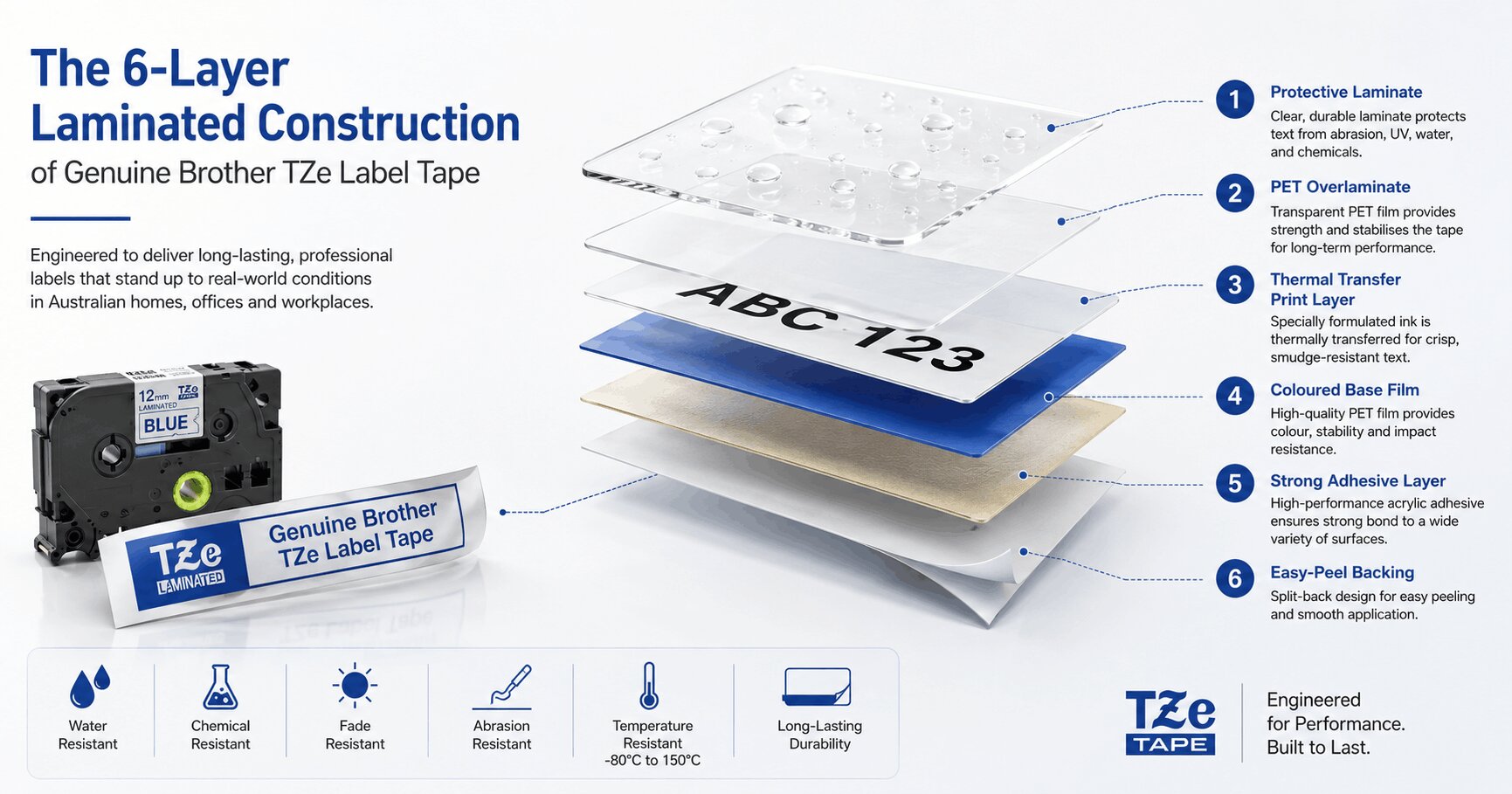
Unlike basic desktop labelers or generic copycats that spray thermal ink directly onto the top face of a substrate, Brother TZe tape uses a completely different sub-lamination method. The text is printed backwards onto the inner surface of a protective polyethylene terephthalate (PET) film layer via a dedicated thermal ink ribbon transfer process. This seals the ink layer completely between two layers of plastic film, before the adhesive backing is even applied. Surface friction, heavy-handed cleaning, or physical scraping can't touch the print, because the text sits underneath the protective plastic layer, not on top of it.
According to Brother's own technical documentation, the laminated sandwich consists of the following layers, from top to bottom:
- Protective PET coating
- Acrylic adhesive layer
- Coloured PET base film (carries the printed lettering on its underside)
- Acrylic adhesive layer
- Backing paper (removed on application)
This combined structure forms a total nominal thickness of approximately 160 micrometres, though this varies slightly by tape type.
Heat Resistance: Site Sheds and Hot Vehicle Dashboards
Leaving tools in a heavy iron chest, trade utility tray, or on a vehicle dashboard in direct sun can push interior temperatures up fast. In inland New South Wales, the Northern Territory, or Western Australia, closed cabin temperatures regularly cross 65°C to 75°C. Generic, unlaminated tapes tend to fail under these conditions as their cheap adhesives soften, causing the backing to bubble, yellow, or curl off your tools.
Genuine laminated TZe tapes are factory tested to hold up across an in-use temperature range from -80°C to +150°C. Brother's own thermo-chamber testing held labels at -80°C for 3 days and +150°C for 2 days. Results showed no peeling or structural adhesive failure, with only minor tape discolouration at the extreme upper limit. For sustained high heat, such as engine bays, industrial ovens, or outdoor switchboards in direct summer sun, Brother specifically recommends the TZe-M931/951/961 black-on-matt-silver range as the most discolouration-resistant option.
It's worth separating this in-use durability from unopened storage conditions. Brother's technical data notes that unopened TZe cassettes have a storage shelf life of approximately 15 months when kept between -10°C and +45°C, away from direct sunlight, moisture, and chemical vapours.
Resistance to Solvents, Oils, and Commercial Cleaners
The top PET protective layer acts as a barrier against chemical degradation. In industrial processing facilities, electrical substations, or automotive workshops, labels often come into contact with aggressive liquids. Brother has published lab data from two-hour chemical immersion tests followed by a 100-pass weighted rub test. Citing Brother directly, TZe tapes were tested against and showed no change in print legibility or adhesive bonding when exposed to:
- Toluene
- Hexane
- Ethanol
- Ethyl acetate
- Acetone
- Mineral spirit
- Dilute hydrochloric acid (HCl)
- Dilute sodium hydroxide (NaOH)
- A named range of industrial cutting oils
Performance against fluids outside this tested list, including common substances like isopropyl alcohol or fuel, isn't something Brother has published data on. Treat resistance to those as untested rather than assumed.
Matching Brother P-Touch Hardware to Tape Widths
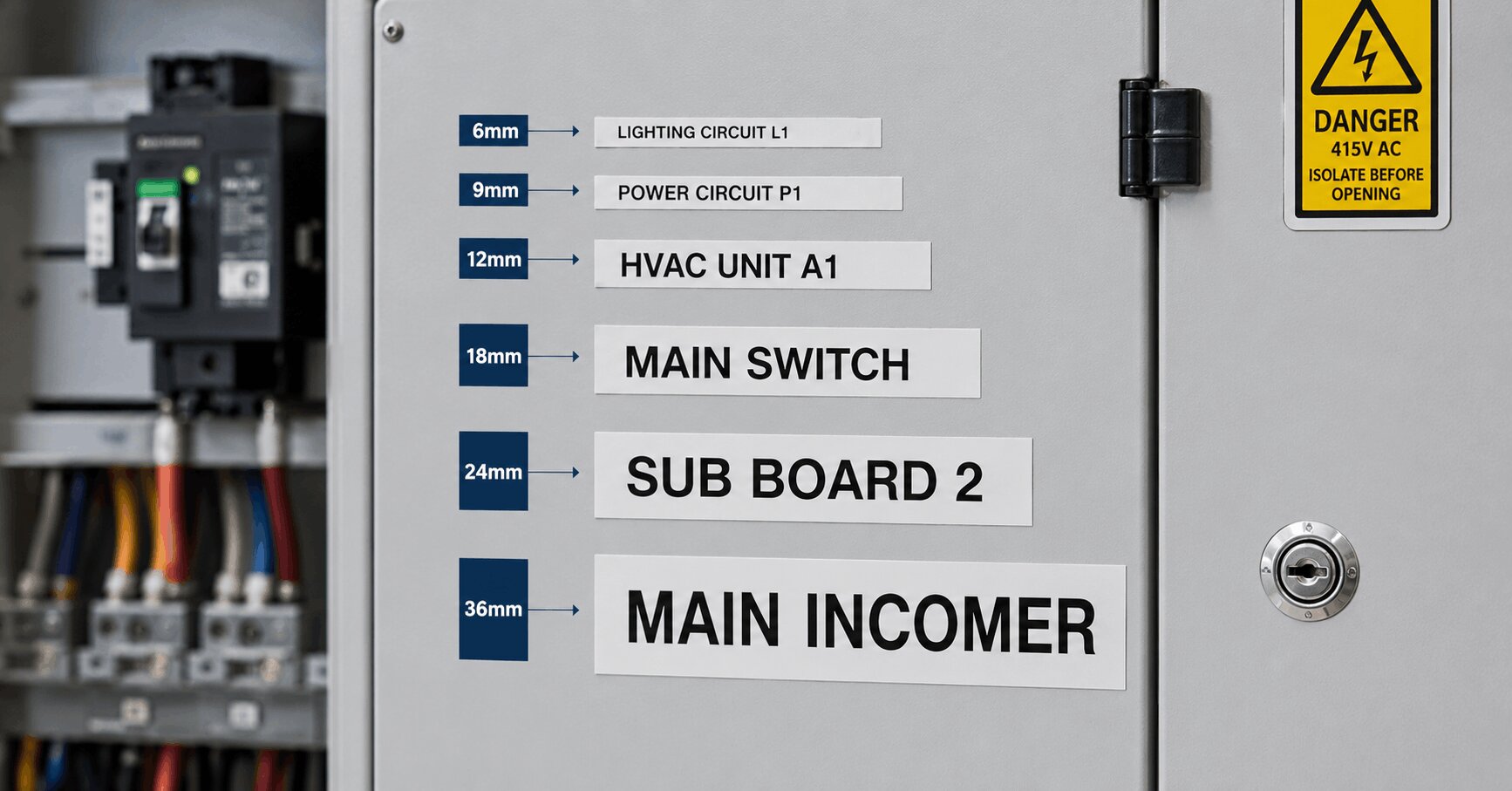
Supports 3.5mm, 6mm, 9mm, and 12mm cassettes. Engineered for simple onsite labelling, domestic organisation, and small asset tagging.
Supports widths up to 18mm and 24mm. Designed for commercial office filing, warning labels, and barcode asset tracking arrays.
Supports widths up to 36mm. Built for large-format compliance signage, wide conduit identifiers, and high-output data centre labelling.
Category A: Compact Handheld & Personal Printers (3.5mm to 12mm Capacity)
This class includes popular hardware variants like the PT-H110, PT-D210, PT-H107, and PT-H110BK. These entry-level systems use compact drive gear assemblies and a scaled-down thermal head array. They're mechanically limited to tape widths up to a maximum of 12mm. Larger 18mm or 24mm cassettes physically won't fit; the guide pins and alignment slots inside the housing aren't built to receive them.
Category B: Desktop Workhorses & Connected Office Systems (Up to 18mm / 24mm Capacity)
This mid-range segment consists of devices like the PT-D410, PT-D460BT, PT-P710BT (Cube Plus), and PT-D610BTVP. With thermal printheads capable of resolutions from 180dpi up to 360dpi, these devices easily handle medium to extra-large tape formats. They're the standard choice for professional office environments, warehouse managers, and custom trade setups that need bold barcode tracking layouts, multi-line shelving text, and prominent danger warnings.
Category C: High-Output Industrial Label Engines & Network Systems (Up to 36mm Capacity)
This heavy-duty category includes high-end industrial hardware such as the PT-E550WVP, PT-P900W, PT-P950NW, and the PT-D800W. These platforms have extra-wide printhead clearances designed to drive large 36mm tape sizes. They're built for trade professionals who need to print large industrial compliance signage, wide conduit identifiers, or complex multi-tier hazardous chemical warnings across data facilities and commercial job sites.
The Downward-Width Rule: Any P-touch device can run any tape width narrower than its maximum rated limit. A 24mm-capable desktop unit will happily accept 18mm, 12mm, 9mm, 6mm, or 3.5mm cassettes. The onboard micro-switches automatically detect the narrower housing and centre the print layout on the inserted tape. It simply can't accept a cassette wider than its own maximum.
Retrofitting Legacy Hardware: The Shift from Old 'TZ' to Modern Eco 'TZe' Cassettes
Older Brother P-Touch labelers used legacy "TZ" tape cassettes. Modern variants carry the "TZe" badge, with the "e" standing for eco-conscious design. These modern cassettes use a lighter housing that has up to 15% less plastic by weight than original versions, and the cassette case now contains at least 5% recycled material. They use small, physical sensor recesses on the underside of the plastic shell rather than digital chips. These cutouts engage directly with a set of spring-loaded mechanical micro-switches built into the floor of modern P-Touch compartments. This tells the labeller exactly what width, base colour, and material type is currently loaded without needing manual menu configuration.
Specialised Substrates and Industrial Tapes
Standard Laminated TZe (8-Metre Yield): General Labelling Applications
This is the standard choice for flat surfaces like office files, plastic storage tubs, smooth shelf edges, and school exercise books and gear. It performs consistently on low-friction items but struggles on round surfaces or textured metals. Standard variants include Black on Clear (TZe-131), Black on White (TZe-231), and Black on Yellow (TZe-631).
Strong Adhesive TZe-S (8-Metre Yield): For Powder-Coated and Textured Surfaces
This modified acrylic adhesive is Brother's answer for rough surfaces like powder-coated metals, textured plastic toolboxes, and brickwork. Brother's own JIS Z 0237 peel-force testing (12mm tape, measured at a 180-degree removal angle after 30 days) shows Strong Adhesive tape averaging roughly three times the adhesive force of Standard tape on textured or industrial surfaces. Substrates like polyamide and PET showed the largest gains, in the 3–4x range, while smooth surfaces like polyethylene showed a smaller but still meaningful improvement. Popular codes include TZe-S231 (White) and TZe-S641 (Yellow).
Flexible ID TZe-FX (8-Metre Yield): Preventing 'Flagging' on Cables and Radiuses
Standard PET tape has a degree of physical shape memory. When wrapped tightly around a small diameter, like a Cat6 data line or a narrow electrical core, the stiff backing behaves like a spring, trying to snap back flat. Over time, this constant tension overcomes the adhesive layer, causing the label ends to pop loose and stand upright. This is known in the trade as "flagging."
Flexible ID (TZe-FX) cassettes use a specialised, ultra-pliable carrier film that relaxes and dissipates internal tension when wrapped around tight radiuses. In Brother's own curved-surface adhesion testing, Standard and Strong Adhesive tape peeled or detached completely when wrapped or flagged around a 3mm-diameter tube, while Flexible ID tape showed no peeling at all. Brother rates Flexible ID as suitable for cable wrapping and flagging down to a 3mm minimum diameter. Look for common variants like TZe-FX231 and TZe-FX631.
Self-Laminated TZe-SL (8-Metre Yield): Embedded Protection for High-Contact Wires
Designed mainly for network engineers and data technicians working across dense patch bays. This cassette prints your text onto a narrow, solid-coloured backing strip, while an extra-long clear tail extends outwards from the cartridge. As you wrap the label around a data cable or wire, this clear tail winds completely over the printed text, giving an integrated second layer of lamination that guards against mechanical wear and pulling forces. Brother notes that Self-Laminating tape shares the same underlying adhesive and material properties as Flexible ID tape, making it an equally valid choice for cable wrap applications down to the same 3mm minimum. Look for part number TZe-SL251.
Heat-Shrink Tubes (HSe Series, 1.5-Metre Yield): Permanent Electrical Insulation Sleeves
A completely non-adhesive, specialised polyolefin tube option for industrial environments. This tube cartridge prints text directly onto an insulated sleeve that you slide over exposed electrical wires or terminal ends. A standard heat gun triggers a 3:1 physical reduction ratio, shrinking the material tightly around the copper core for neat insulation and permanent classification. Sizing matters here: HSe-211E (5.2mm) is rated for cables around Ø0.8–3.1mm after shrinking, HSe-221E (9mm) for Ø1.6–5.4mm, HSe-231E (11.2mm) for Ø2.1–7.0mm, HSe-251E (21mm) for Ø4.2–13.5mm, and HSe-261E (31mm) for Ø6.3–20mm.
Tamper-Evident Security TZe-SE (8-Metre Yield): Defending Asset Warranties
Built for IT infrastructure asset tracking and high-value hardware enclosures. If someone tries to peel back this security label, the underlying adhesive bond ruptures in a precise, geometric way. The tape splits, leaving behind a permanent checkerboard pattern on the equipment surface that clearly shows unauthorized access, immediately voiding any service warranties. TZe-SE4 comes in 18mm width and TZe-SE5 in 24mm; Brother recommends letting a security label sit for at least 24 hours after application before relying on it to function correctly.
Textile & Specialty Craft TZe Variations: From Iron-On Fabric to Non-Adhesive Ribbons
For jobs beyond industrial labelling, Brother produces non-laminated fabric tapes and iron-on consumables. Fabric ribbons lack adhesive layers entirely and are used for custom corporate presentation packaging, while iron-on options like TZe-FA3 fuse directly into uniform fibers, handling repeated industrial laundry cycles without coming loose. Brother's current Australian catalogue also includes a decorative "Deco/Pattern" laminated range (glitter, gingham, lace, and novelty backgrounds), a non-adhesive Ribbon series for gift and craft presentation, and a non-adhesive Stencil tape (STe-141/151) for etching or engraving applications. These are niche options, but worth knowing about even outside core industrial use.
Official Brother Durability Test Data
Every durability claim made about TZe tape above is backed by Brother's own published Australian technical data sheet, tested to recognised standards (JIS Z 0237 for adhesion, JIS K7350-2/ISO 4892-2 for fade resistance). A few of the more useful figures for planning a labelling job:
| Test Category | What Was Tested | Official Performance Findings |
|---|---|---|
| Abrasion Resistance vs. Named Competitors | Standard, Strong Adhesive, and Flexible ID TZe tapes vs. Dymo and Brady non-laminated tapes; a 1kgf weighted sanding device, 50 continuous passes. | TZe text remained fully legible with only minor surface scratching. Several named competitor tapes were rendered partially or completely illegible after the same test. |
| Fade Resistance by Substrate Colour | Simulated 1 year of outdoor solar exposure (478 hours of continuous UV radiation). | Text stayed fully legible on every colour. Fluorescent background colours (orange and yellow) showed a much larger colour shift (ΔE) than standard black, white, or blue tape. |
| Salt & Pure Water Immersion | 30-day immersion at 40°C in pure water and a 5% sodium chloride solution. | No peeling, no adhesive softening, no text fade across Standard, Strong Adhesive, or Flexible ID tape. |
| Autoclave Sterilisation | Flexible ID tape run through a steam steriliser at 134°C. | Labels survived up to 30 cycles before minor laminate edge separation and slight discolouration appeared; printed text remained fully readable. |
| Oil and Solvent Resistance | 2-hour immersion and 100-pass rubbing with industrial cutting oils and the nine chemicals listed above. | No change to print quality and no loss of adhesion. |
For compliance-sensitive Australian workplaces, Brother's technical data sheet confirms Strong Adhesive, Flexible ID, and Security TZe tapes hold UL recognition (Underwriters Laboratories file number PGJI2.MH21016). TZe tapes are RoHS-compliant, containing no lead and no latex. The acrylic adhesive layer is not halogen-free, however: the coloured base film contains a trace chlorine compound, with the exception of clear and silver variants. The tape liner is also silicone-coated on both sides, so trace amounts of silicone can transfer to the adhesive during backing removal. This is standard for this type of product and isn't flagged by Brother as a performance issue.
Width vs Colour Part Number Directory
Once you've settled on a tape family (Standard, Strong Adhesive, or Flexible ID), colour becomes the next practical decision. It's useful for building a consistent visual system across a workshop, data rack, or switchboard. The table below is checked directly against Brother's official Australian TZe tape catalogue (PDF).
| Print / Background Colour | 6mm | 9mm | 12mm | 18mm | 24mm | 36mm |
|---|---|---|---|---|---|---|
| Black on White (Standard) | TZe-211 | TZe-221 | TZe-231 | TZe-241 | TZe-251 | TZe-261 |
| Black on Clear (Standard) | TZe-111 | TZe-121 | TZe-131 | TZe-141 | TZe-151 | TZe-161 |
| Black on Yellow (Standard) | TZe-611 | TZe-621 | TZe-631 | TZe-641 | TZe-651 | TZe-661 |
| Black on Red (Standard) | — | TZe-421 | TZe-431 | TZe-441 | TZe-451 | TZe-461 |
| Black on Blue (Standard) | — | TZe-521 | TZe-531 | TZe-541 | TZe-551 | TZe-561 |
| Black on Green (Standard) | — | TZe-721 | TZe-731 | TZe-741 | TZe-751 | — |
| White on Black (Standard) | TZe-315 | TZe-325 | TZe-335 | TZe-345 | TZe-355 | — |
| White on Clear (Standard) | — | — | TZe-135 | — | — | — |
| White on Blue (Standard) | — | — | TZe-535 | — | TZe-555 | — |
| Red on White (Standard) | — | TZe-222 | TZe-232 | TZe-242 | TZe-252 | TZe-262 |
| Blue on White (Standard) | — | TZe-223 | TZe-233 | TZe-243 | TZe-253 | TZe-263 |
| Gold on Black (Standard) | — | — | TZe-334 | TZe-344 | TZe-354 | — |
| Black on White (Strong Adhesive) | TZe-S211 | TZe-S221 | TZe-S231 | TZe-S241 | TZe-S251 | TZe-S261 |
| Black on Yellow (Strong Adhesive) | — | TZe-S621 | TZe-S631 | TZe-S641 | TZe-S651 | TZe-S661 |
| Black on Clear (Strong Adhesive) | — | — | TZe-S131 | TZe-S141 | TZe-S151 | — |
| Black on White (Flexible ID) | TZe-FX211 | TZe-FX221 | TZe-FX231 | TZe-FX241 | TZe-FX251 | TZe-FX261 |
| Black on Yellow (Flexible ID) | TZe-FX611 | TZe-FX621 | TZe-FX631 | TZe-FX641 | TZe-FX651 | TZe-FX661 |
All part numbers above are cross-checked against Brother's official Australian TZe tape catalogue. A dash (—) means that width/colour combination isn't manufactured, not that it's simply omitted from this table.
Genuine vs Compatible Tape: An Honest Trade Assessment
Deploying third-party or "compatible" TZe cassettes is a common way to lower upfront costs. It's a reasonable strategy for some jobs, but it comes with trade-offs worth weighing honestly rather than dismissing outright:
- Sub-lamination shortcuts: many cheaper compatible tapes skip the dual-film sub-lamination process and print directly onto the top face instead, leaving text more exposed to scraping and chemical exposure than genuine TZe's fully-encased construction.
- Adhesive consistency: compatible cassettes vary a lot by manufacturer. Some perform close to genuine tape indoors, while lower-grade ones can dry out or lose grip faster under heat, particularly in vehicles or outdoor enclosures exposed to the Australian sun.
- Cassette tolerances: minor shell or feed-gear tolerance issues in some third-party cassettes can cause tape bunching or premature printhead contamination in certain printer models. This varies by supplier and isn't universal.
For temporary or low-stakes indoor labelling, like filing, pantry organisation, or short-term sorting, a reputable compatible tape is usually a sound way to cut cost. For labels tied to safety compliance, warranty-relevant asset tags, or anything installed somewhere hard to re-visit, genuine Brother TZe removes that variable entirely, and the published test data in this guide only applies to genuine cassettes.
Reducing the 25mm Margin Tape Waste
A frequent frustration for P-Touch users is the mandatory 25mm blank margin piece ejected right before every individual label print. This is often mistaken for a deliberate trick to make you buy more tape. The real reason is a physical engineering constraint: the thermal printhead assembly inside the device sits exactly 25mm behind the cutting blade module. To centre the text layout properly on the label, the labeller has to feed this 25mm buffer forward past the cutter before printing starts.
[ Printer Frame Chassis ]
+--------------------------------------------+
|  [Cassette Base]                           |
|  (Tape Supply Reel)                        |
|        |                                   |
|        v                                   |
|  [Thermal Printhead]                       |
|        |  <=== (Prints text here)          |
|        v                                   |
|  =======[ 25mm Physical Fixed Distance ]===|
|        v                                   |
|  [Mechanical Cutter Blade Assembly]        |
|        |  <=== (Cuts completed tape here)   |
+--------|-----------------------------------+
         v
   [ Ejected Tape ] ---> (Leaves mandatory 25mm blank margin)
You can override this mechanical waste on desktop and premium handheld devices by adjusting your printer's internal firmware options or using Brother's P-Touch Editor design software.
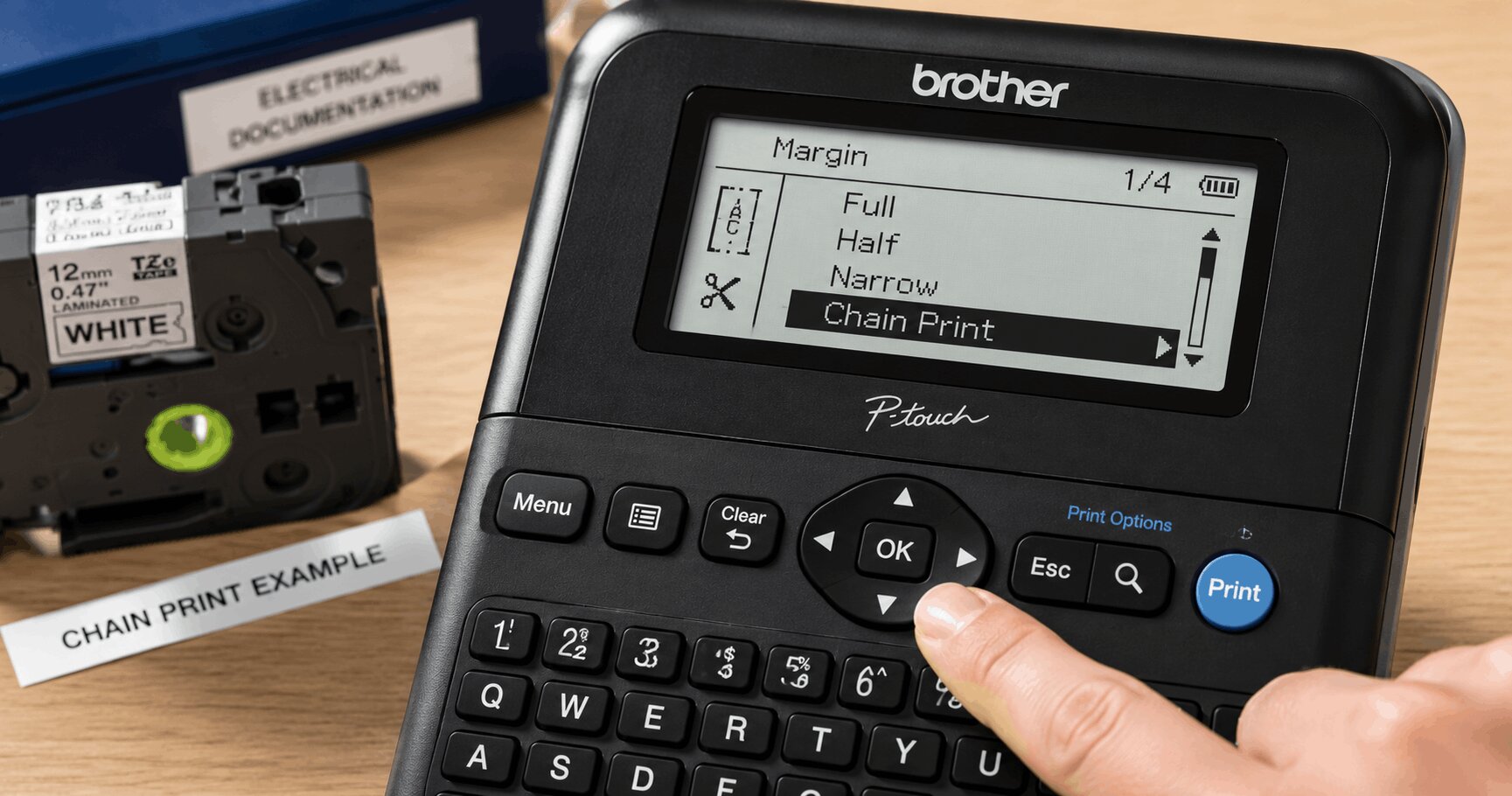
- Enter the Layout Options Menu: Turn on your P-Touch device and press the [Menu] or [Function] key on the keyboard to access the internal system options.
- Navigate to Margin Settings: Scroll through the submenus using the arrow keys until you locate the [Margin] configuration line, then hit [OK].
- Switch Options to Chain Print: Change the setting from the standard [Full] option to [Chain Print] and confirm the choice. This tells the printing engine to pause without running a full tape cut cycle between labels, enabling efficient multi-label print runs with minimal waste.
- Execute the Batch Cut Sequence: Once your entire label sequence is finished printing, press the manual [Feed/Cut] shortcut keys on your device to clean-cut the completed batch tape run from the device.
Troubleshooting Mechanical and Print Quality Problems
- "No Tape Installed" Error: Clean the bottom area of the tape cassette and check the alignment of the base identification slots. Clear away any accumulated dust or debris inside the labeller's base compartment using compressed air so the mechanical micro-switches can read the tape specifications accurately. Check that the plastic detection pins aren't bent or obstructed.
- Looped, Bunched, or 'Eaten' Tape: Carefully remove the jammed cassette from the device housing. Take a precision tool or pen tip and insert it into the exposed black plastic core spindle gear on the underside of the cartridge, turning it counter-clockwise to take up any loose ribbon slack. Verify the clear lamination film is winding smoothly with the base ribbon. Trim away any wrinkled or damaged tape edges cleanly before re-inserting the cassette.
- Faded, Split, or Poorly Transferred Print: Gaps or light lines running across printed text usually point to dirt or adhesive residue buildup on the internal heating element. Dampen a lint-free cotton swab with high-purity isopropyl alcohol and gently wipe across the linear glass heating strip inside the printer compartment to clear the thermal path.
Official Brother Sources & Further Reading
Every technical spec, part number, and test result in this guide is drawn from Brother's own published Australian resources. For full detail beyond what's summarised here, refer to:
- Brother Australia: Label Tape & Rolls overview. Benefits of TZe tape, use-case categories, and the DK label roll range.
- TZe Tapes Technical Data (PDF). The full durability test report, including adhesion force figures, fade resistance by colour, abrasion testing against competitor tapes, temperature and chemical resistance data, UL certification, and material safety FAQs.
- TZe Tape Catalogue (PDF). The complete official part number directory across every width, colour, and tape family in the current Australian range.
Frequently Asked Questions (FAQs)
Why do Brother P-Touch printers leave a 25mm blank margin before every label?
This blank space is due to the physical distance between the internal thermal print head and the integrated manual cutting blade assembly inside the printer chassis. The labeller must feed this 25mm buffer forward so your printed text layout centres correctly on the label.
Can I use standard TZe label tape to wrap around data cables and electrical wires?
Standard TZe tape isn't recommended for cable wrapping. Standard tape has material shape memory that causes it to spring back flat, leading to "flagging" (edges lifting) over time. Brother's own testing shows standard and strong adhesive tapes failed and detached when wrapped around a 3mm diameter tube. Use Flexible ID (TZe-FX) or Self-Laminating (TZe-SL) tape for curved profiles down to a 3mm minimum diameter.
Are Brother TZe labels safe for use near food packaging or medical devices?
TZe labels are considered safe for use on the exterior of food packaging, though they shouldn't be placed in direct contact with food itself. They're RoHS-compliant and contain no lead or latex. Flexible ID tape has also been tested through up to 30 autoclave sterilisation cycles at 134°C, making it suitable for labelling lab and medical equipment housings, though this doesn't extend to any use inside the human body.
Can TZe labels be used on electronic circuit boards or bare copper?
Brother doesn't recommend applying TZe labels directly to circuit boards or bare copper. Circuit boards are sensitive to static electricity, dust, and mild acidity; since the TZe acrylic adhesive is weakly acidic, it isn't recommended on bare copper surfaces either.
How long should I wait after applying a Tamper-Evident security label?
Brother recommends leaving a security label (TZe-SE4 or TZe-SE5) undisturbed for at least 24 hours after application, giving the adhesive time to form a full bond with the substrate so any later removal attempt correctly triggers the checkerboard void pattern.
What is the shelf life and correct storage condition for unopened TZe tapes?
Unopened TZe cassettes have a shelf life of approximately 15 months from manufacture. Store them out of direct sunlight, away from moisture and chemical vapours, at temperatures between -10°C and +45°C. Once applied, TZe labels are rated for a much wider in-use range of -80°C to +150°C.
Can I peel off a TZe label and reuse it somewhere else?
No. TZe tape is designed as a permanent, one-time application. Once removed, the adhesive has already bonded to the original surface and won't hold reliably on a second one, so reused labels tend to lift at the edges and fail early.


Any comments?