
How to Choose POSCA Pens & Paint Markers: An Australian Guide for Drawing, Craft & Projects

Match the tip size to your project scale first: fine tips suit detail work, medium tips handle general use, and broad chisel tips cover large fills or signage.
From there, decide between a single colour for restocking or a targeted job, or an assorted set for classroom, beginner or varied-colour work, and always check your surface, since POSCA is permanent on porous materials but removable on glass, metal and plastic unless sealed.
What Makes POSCA Different From a Regular Marker?
POSCA pens use a water-based, pigment-rich paint rather than standard marker ink. That's why they sit opaquely on top of dark or glossy surfaces instead of soaking in like a felt-tip, and it's also why the buying decision is different: instead of just picking a colour, you're choosing a tip size, an ink coverage level, and a surface match all at once.
The full genuine POSCA paint markers range covers everything from fine detail pens to broad chisel tips, and the three steps below will help you narrow that down to what your project actually needs.
Step 1: Match the Tip Size to Your Project
POSCA tips fall into three practical categories, and getting this wrong is the single most common reason people end up disappointed with their first pen.
Best for lettering, linework, small illustrations and detail on jewellery, cards or miniatures.
The most versatile option for general craft, canvas work and everyday projects, and usually the best place to start.
Suited to large fills, backgrounds, posters and signage where speed and coverage matter more than fine detail.
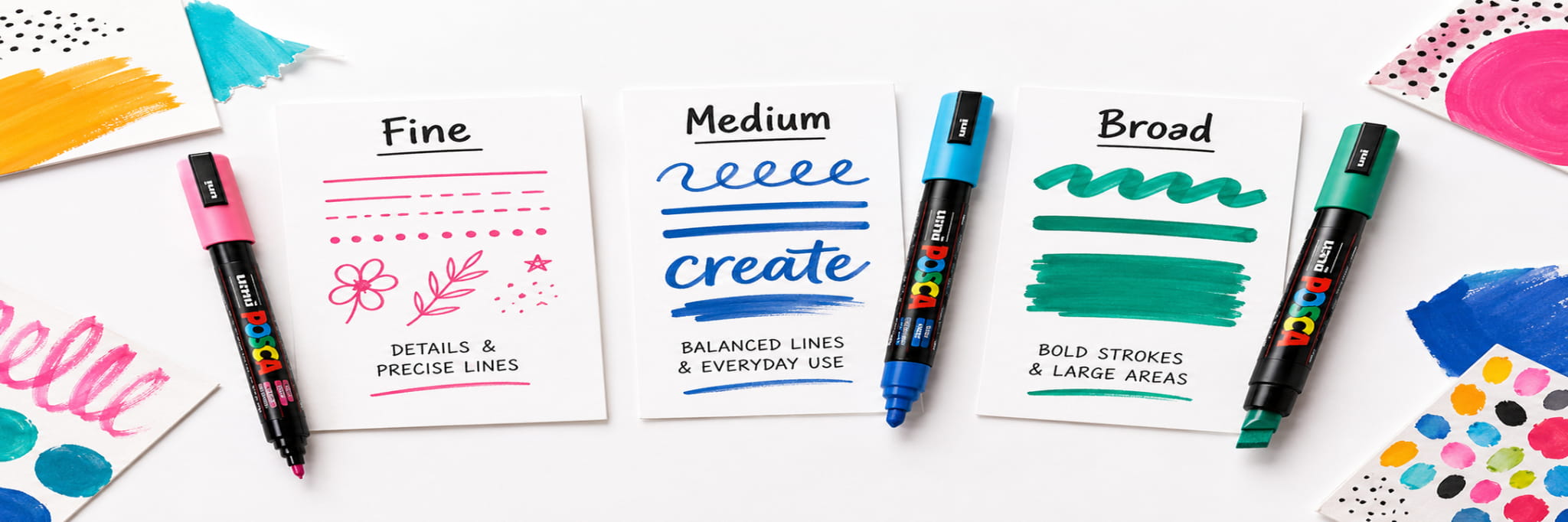
Manufacturer specifications put a medium tip like the PC-3M in roughly the 0.9–1.3mm range, but exact widths vary by model, so check the current product page for the precise figure before buying. A single fine-tip pen used across a large canvas will mean hours of tedious fill work and visible streaking: a scale mismatch that a spec sheet alone won't warn you about.
If you want the exact mm width for every model side by side, the full POSCA tip size chart on our brand page covers all current tip options and applications.
Step 2: Single Colour or a Set?
This is a frequency decision more than a spec decision. If you're restocking a colour you use often, or working on a one-off outdoor job like a letterbox or garden sign, a single pen usually makes more sense than buying a whole set again. If you're setting up a classroom, running a recurring craft activity, or you're new to POSCA and don't yet know which colours you'll reach for, an assorted set gives you more flexibility per project.
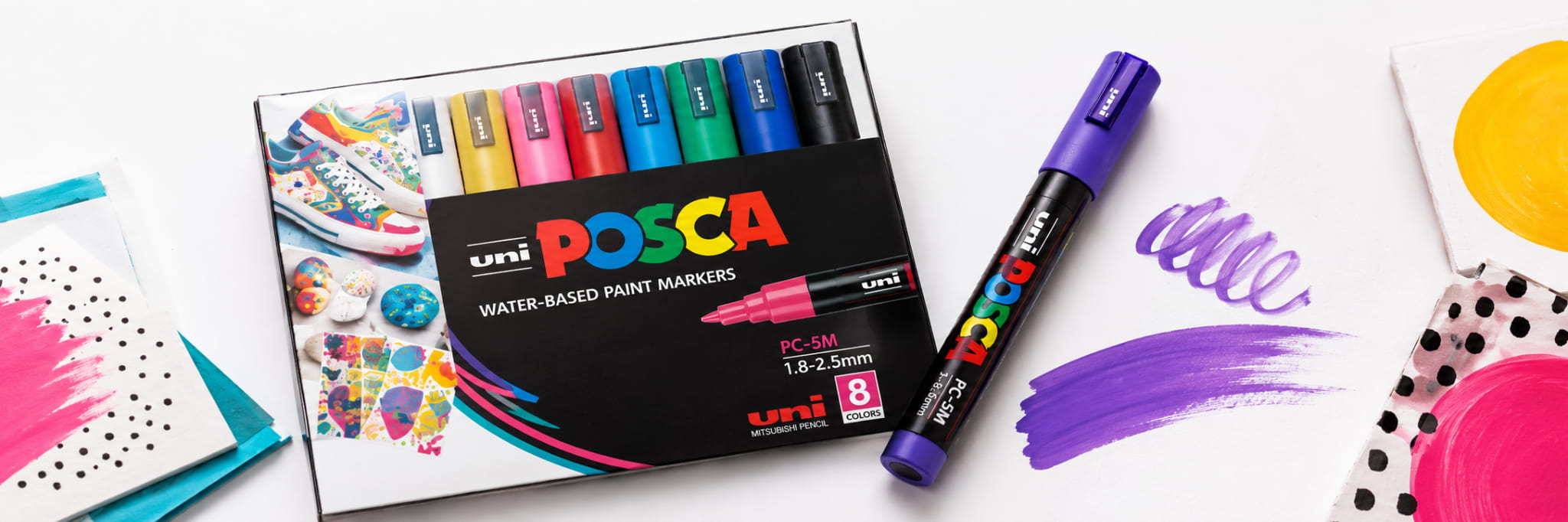
Opaque POSCA colours generally need two coats over dark backgrounds to look fully solid, and that catches a lot of new buyers out: they assume one marker will cover a finished project start to finish. Factor coverage into how many pens (or how much ink) a project will realistically use, not just how many colours you want.
A small mixed-tip pack covers most beginner projects without needing to guess ahead; you can always add single colours later once you know what you use most.
Step 3: Check Your Surface
POSCA behaves differently depending on what you're drawing on. On porous surfaces like paper, card, wood and fabric, the ink dries permanent. On non-porous surfaces such as glass, ceramic, metal and plastic, it stays removable unless it's properly sealed. That matters if you're customising something you plan to keep long-term rather than wipe clean.
Check your surface before you buy, not after: it determines which sealing or heat-setting steps you'll need later, and those are covered in more detail in our other POSCA guides below. For the complete list of porous and non-porous surfaces POSCA is suited to, browse the full range of genuine POSCA paint markers, where the current product range is listed alongside the full breakdown.
POSCA Buying Guide by Project Type
Once you know your tip size and surface, matching to a real project makes the final decision easier.
Kids' Craft & Classroom
Medium tips and assorted sets are the practical default for classroom and family use, since they cover the widest range of activities without constant swapping. POSCA ink is AP-certified non-toxic and conforms to ASTM D-4236, but for the full safety breakdown relevant to Australian classrooms, see our guide on whether POSCA markers are safe for kids.
Canvas & Paper Art
Medium tips handle most canvas and paper work, with a fine tip added for detail and outlining once the main areas are filled in. Remember the two-coat rule for opaque colour over darker paint or paper.
Shoes, Fabric & Wearables
Medium tips are the common choice for shoe customisation and fabric work. Fabric applications, though, need a heat-setting step to make the design wash-resistant; our guide to using POSCA pens on fabric walks through that process in full.
Mugs, Glass & Ceramics
Broad or medium tips both work well here depending on the design, but POSCA is removable on glass and ceramic unless sealed, so check our dedicated guide on sealing POSCA pens on glass, wood and ceramic before starting anything you want to be dishwasher-safe or long-lasting.
Outdoor Signage & Large Projects
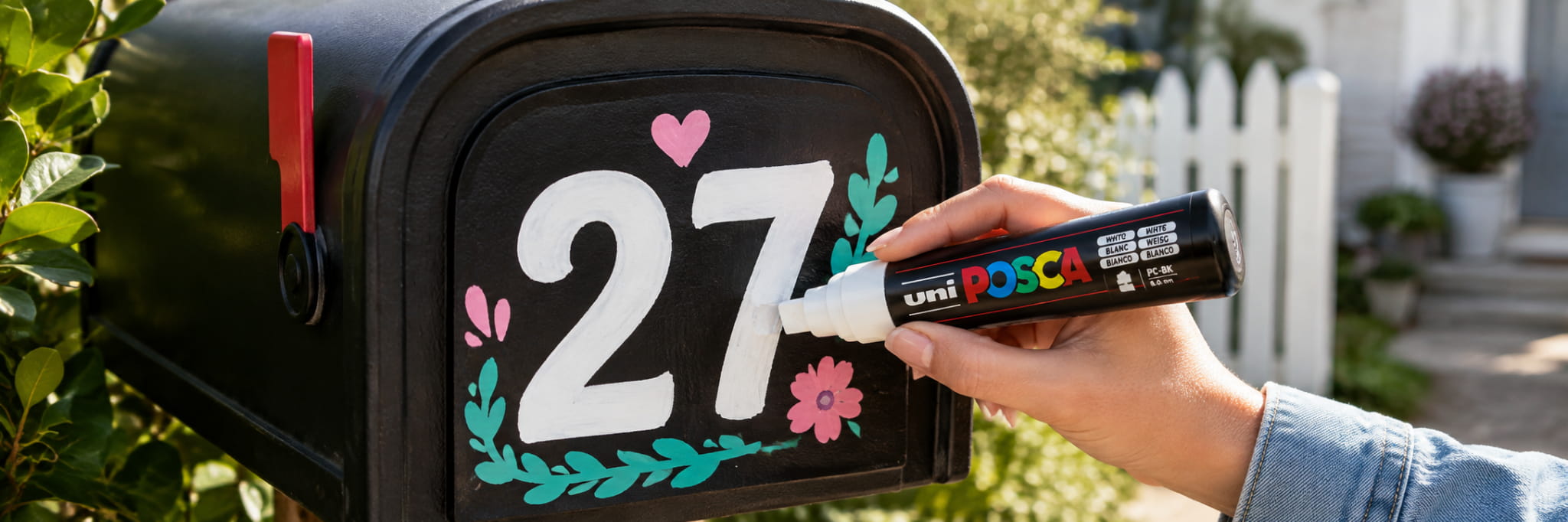
Broad chisel tips are the practical choice for letterboxes, garden signs and other large outdoor pieces: they cover more area per stroke than a medium or fine tip, so large jobs go faster. Australia's UV exposure is stronger than in many of the regions overseas buying guides are written for, and while POSCA ink resists fading in sunlight, it isn't an unlimited outdoor-permanence claim, so plan to check and refresh outdoor pieces periodically rather than treating them as a one-time job.
Common Mistakes When Choosing a POSCA Pen
Most POSCA buying regrets come down to a handful of avoidable mismatches. A fine tip used on a large canvas or sign means slow, streaky coverage instead of clean fills. The two-coat rule for opaque colour over dark backgrounds catches people out when they assume one marker will finish a project from start to finish. Single colours bought for a classroom or a recurring activity usually end up costing more over time than an assorted set would have. And a design that needed sealing or heat-setting often only becomes obvious once the surface check gets skipped and the pen's already been bought.
Testing a new pen on scrap paper, or an offcut of your actual material, is a simple way to avoid surprises: how a tip lays down colour can vary slightly by surface, so a quick test before starting the finished piece is worth the two minutes it takes.
Working through tip size, colour format and surface in that order avoids most of these issues before you've spent anything.
Frequently Asked Questions
How many POSCA pens do I need for a beginner set?
There's no fixed number. Starting with a couple of tip sizes and a handful of core colours usually works better for a beginner than committing to one large single-tip set straight away.
What's the difference between PC-3M and PC-5M?
Both are medium tips suited to general, everyday use, with a small difference in line width between the two models. For the exact millimetre specifications, check the current product page on our POSCA range.
Can one POSCA pen work on multiple surfaces?
Yes, one POSCA pen isn't restricted to a single material. Results depend on the surface though: expect a permanent mark on porous materials, and a removable one on non-porous surfaces unless it's sealed afterwards. See our full range page for the complete surface-by-surface breakdown.
Do POSCA pens dry out if not used often?
Like most paint markers, POSCA pens can dry out if left uncapped or unused for long periods, so store them horizontally with the cap on and shake and prime the tip before each use. Check the manufacturer's current care instructions for model-specific guidance.
Are sets better value than single colours?
Sets tend to offer better value when you're new to POSCA, teaching a group, or working across lots of colours, while single pens are usually more economical if you're restocking a shade you already use often or tackling a one-off project.


Any comments?