
Are POSCA Markers Safe for Kids? A Guide for Australian Teachers & Parents

Genuine Uni POSCA markers use a non-toxic, water-based acrylic paint carrying the ACMI AP seal and conforming to ASTM D-4236, which makes them a good fit for supervised classroom and home art activities. The manufacturer's own packaging lists them as a choking hazard due to small parts and advises against use by children under 3. The pump-action nib releases paint on pressure and the caps are removable, so an adult needs to be within reach whenever younger children are shaking, priming or recapping them. They are never a substitute for face paint, lipstick, or temporary tattoos.
What's Actually Inside a POSCA Texta?
Walk into any primary school art room during a wet-weather lunchtime club and you'll notice something missing the moment a box of POSCAs gets opened: the sharp chemical smell you'd expect from a permanent marker.
Genuine Uni POSCA pens are made by Mitsubishi Pencil Company and detailed on the official POSCA website. They skip solvents entirely and use a stable, water-based acrylic paint suspension instead. That single choice does a lot of work in a crowded classroom:
- Low odour: there's no alcohol or xylene smell to ventilate away, so there's no need to prop every window open during a full-class session.
- Bleed resistance: the opaque pigment sits on top of the paper fibres rather than soaking through, so students can use both sides of a visual arts diary without ruining the next page.
- ACMI AP certification: genuine markers carry the ACMI Approved Product seal, meaning the formulation has been independently reviewed and contains no materials in sufficient quantity to be toxic or injurious to humans when used as intended.
ASTM D-4236 compliance and the ACMI AP seal mean the product has been reviewed for chronic health hazards and labelled accordingly. Neither means a marker is edible, cosmetic-grade, or safe under every possible misuse. Always check the specific pack you're ordering, especially from marketplace sellers, since ranges and labelling can differ.
Why Kids Still Need an Adult Nearby
POSCA markers look like chunky textas, but the paint comes out through a valve-operated nib, not a simple felt tip. Before first use, the marker gets a firm shake with the cap on, then the tip is pressed repeatedly against scrap paper until paint starts to flow. Simple for an adult. Genuinely fiddly for a five-year-old.
The heavy-handed squeeze
Younger kids don't intuit valve mechanics. If paint isn't flowing fast enough, their instinct is to mash the nib straight down onto the desk. That crushes the felt fibres and splits the tip instead of priming it, ruining the marker for good. Prime markers at the teacher's table before handing them out to junior classes.
Loose caps and choking hazards
The removable caps on fine and ultra-fine POSCAs are genuinely small enough to be a choking hazard. Outdoor sessions make this worse, since a dropped cap disappears into tanbark or grass in seconds. Treat caps like any other small part: enforce a "cap stays on the back of the pen" rule, and count markers back in at the end of the lesson.
The flying droplet risk
Shaking activates a metal mixing ball inside the barrel. You'll hear it click. Shake with the cap on. An uncapped, freshly primed marker shaken loose will fling fine droplets of acrylic paint across uniforms, desks and classroom carpet, and it isn't the kind of spill that vacuums out.
Everyday classroom rules
- Shake only with the cap securely attached.
- Prime vertically on scrap paper or cardboard, never on the artwork itself.
- Use light, sweeping strokes rather than pressing the nib into the surface.
- Keep caps in a labelled tray while markers are in use.
- Keep drinks and food away from the art table.
- Recap firmly the moment a student finishes with a colour.
- Wash hands before eating, even if no ink is visible.
Are POSCA Markers Safe on Skin?
It happens in every session: a student gets a little too enthusiastic and ends up with bright green or fluorescent pink smudges across their knuckles.
POSCA markers are craft tools, not cosmetic face paint. Nothing about the formula has been tested or certified for skin contact, so keep it off faces, lips and eyelids.
An accidental smudge on fingers or wrists is nothing to worry about, because the formula is water-based and lifts off easily with warm water and ordinary soap. What matters is stopping kids from deliberately drawing fake tattoos on their arms or "face painting" each other for sports day. Acrylic paint dries into a flexible film that shrinks and tightens as it cures. That can leave sensitive young skin feeling tight or mildly irritated over a large area, and pigment applied that way can be absorbed rather than just sitting on the surface. Keep the ink on paper, wood, unglazed ceramics and cardboard, and well away from eyes, mouths, and anything that touches food or drink.
POSCA Nib & Age Guide for School Projects
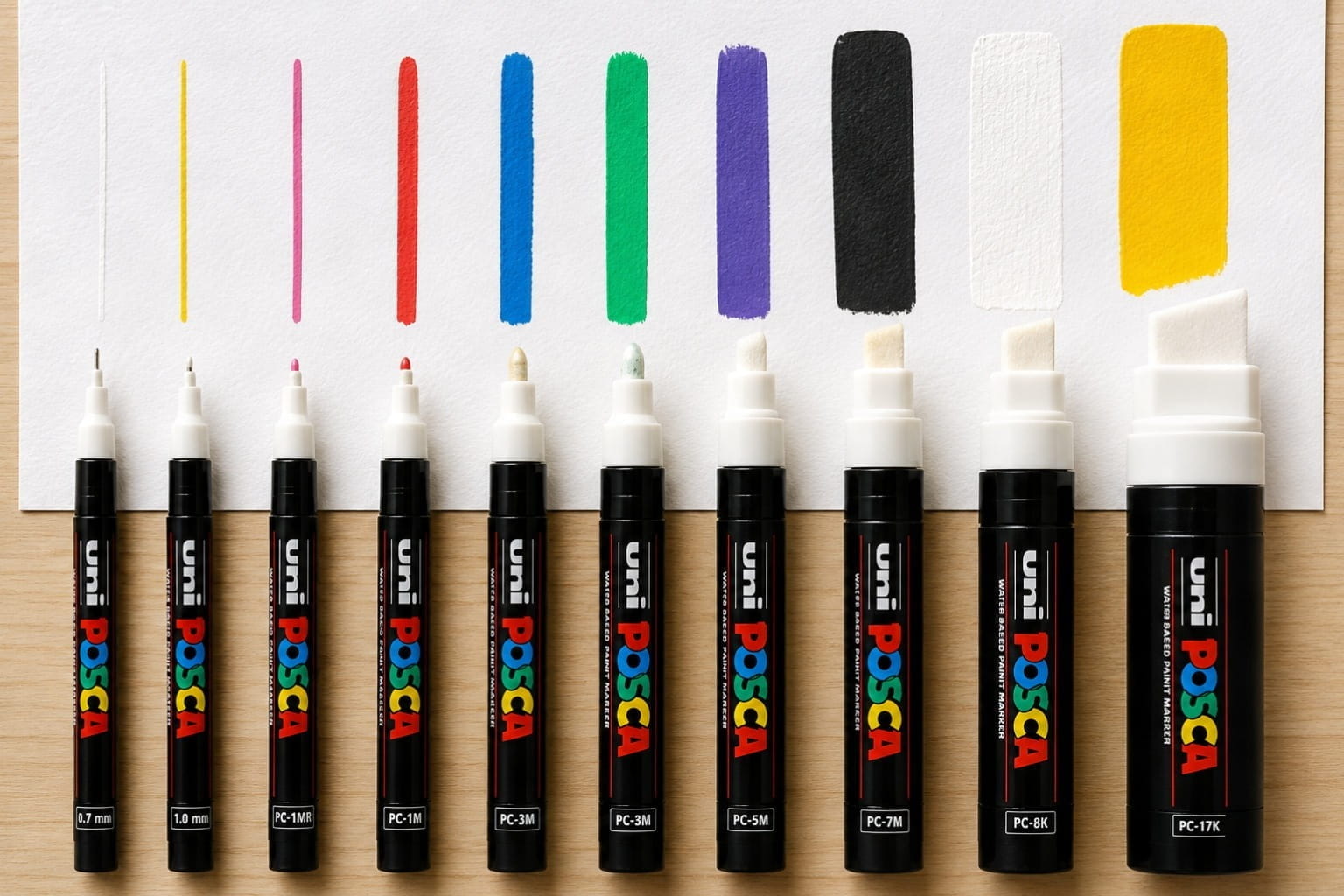
There's no single tip size that's automatically "right" for an age group. It comes down to fine motor control, the project, and how closely the activity is supervised. Use this as a classroom starting point, not a replacement for the age warning printed on the actual product.
| Model | Tip style | Typical school use | Classroom reality check |
|---|---|---|---|
| PC-1MR / PC-1M | Ultra-fine bullet (0.7–1mm) | Detailed lettering, outlines, senior art folios (Years 7–12) | Needs controlled hands. Junior students mashing this nib will bend or split it fast. |
| PC-3M | Fine bullet (0.9–1.3mm) | General drawing, line work, visual diaries (Years 3–6) | A versatile middle-ground for supervised upper-primary work. |
| PC-5M | Medium bullet (1.8–2.5mm) | Posters, rocks, cardboard, canvas bags (Foundation–Year 2) | The reliable classroom default. The thicker nib tolerates heavy-handed pressure far better. |
| PC-8K / PC-17K | Broad chisel (8–15mm) | Large signs, display boards, sports-day banners (all grades, teacher-led) | Efficient for filling big areas fast, but releases a lot of paint. Best kept for adult or supervised group use with a protected work surface. |
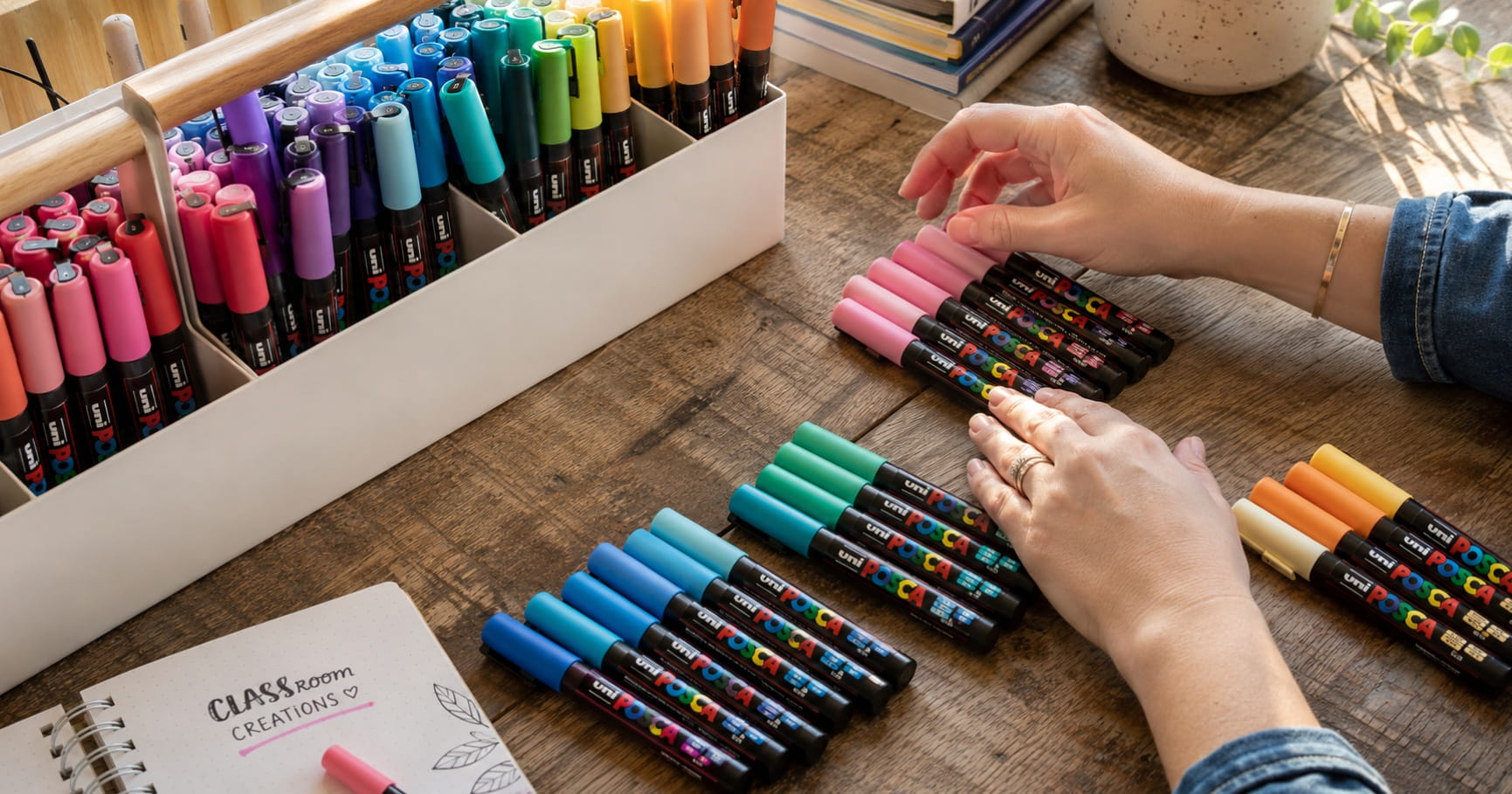
For Foundation and junior primary classes, it's often easier to run a small-group station than to hand a full set to every table: prime the markers first, demonstrate one light press, and limit each group to a few colours at a time.
Sequential Troubleshooting: Wet vs Dried Paint
Respond quickly where you can. Wet water-based paint lifts far more easily than paint that's had time to cure onto a porous surface.
Wet paint on desks, glass or other smooth surfaces
- Move books and pencil cases away from the spill and blot excess paint with paper towel rather than wiping it wider.
- Wipe gently with water using a damp cloth while the paint is still wet.
- If that's not enough, add a small amount of dishwashing liquid to the damp cloth, then wipe over with clean water.
- Check the surface finish before you start scrubbing. Skip abrasive pads on laminates or glossy furniture, since the cleaning tool can do more damage than the paint.
Dried paint on smooth surfaces
- Hold a warm, damp cloth over the mark for a minute to loosen the dried acrylic film.
- Rub gently with mild soapy water, repeating a few times rather than reaching straight for a solvent.
- Once acrylic paint fully cures it becomes a thin plastic film. If soap and water alone won't shift it, hold a cotton pad with a little rubbing alcohol (isopropyl alcohol) on the mark for a minute or two. This softens the bond enough to gently lift with a plastic scraper or the edge of a spoon.
- Test any stronger cleaner on an inconspicuous spot first and follow the furniture manufacturer's care instructions.
Paint on paper, cardboard or unsealed wood
These surfaces absorb the pigment, so complete removal usually isn't possible. Let it dry and cover the mark with another opaque layer, a paper shape, or turn it into part of the design.
Paint on a cotton/poly school uniform
- Act before it dries. Turn the garment inside out and flush the back of the stain under cool running water.
- Blot rather than scrub, since scrubbing pushes pigment deeper into the weave.
- Work in a little laundry detergent and rinse according to the garment's care label.
- Skip the tumble dryer and iron until you're sure the stain is gone, because heat sets any pigment left behind.
- If it's already dried, the alcohol-and-scrape method above can work on cotton or poly-blend items, but test it on a hidden seam first and avoid it on wool jumpers or anything delicate, where alcohol can affect the colour or texture.
Safe Project Ideas for Australian Classrooms
- Cardboard name plaques for classroom doors
- Painted wooden shapes for a class mural
- Decorated canvas library bags
- Harmony Week or NAIDOC Week display lettering, created within the school's cultural guidance
- Rock-art garden markers for a school vegetable patch
- Book Week costume props made from cardboard rather than painted directly on skin
- Reusable playground-duty activity signs
- Senior visual-art studies on canvas, ceramic tiles or prepared timber panels
Slip a sheet of cardboard inside tote bags and T-shirts before decorating them. It stops wet paint transferring through to the other side and gives a firmer surface to draw on.
Using POSCA on Shoes and Uniform Items
Customising canvas shoes, sports bags or pencil cases is a popular project with older students, and POSCA adheres well to canvas, leather and synthetic materials. But dry doesn't mean permanent. Check the item's care label, test a hidden section first, and have an adult apply any heat-setting or clear water-based varnish in a well-ventilated space. Check the school's uniform policy before anyone starts, too. A great art project isn't much use if the shoes can't be worn to school afterwards.
Storing Markers Between Lessons
Replace the cap firmly every time. Most POSCA models can be stored in any position because the internal mixing ball lets the paint be remixed before use. POSCA brush markers are the main exception and store best horizontally. For a classroom set, horizontal trays are still the practical choice: teachers can see every colour, count markers quickly, and spot a missing cap before the bell.
- Store away from excessive heat.
- Keep caps attached during transport.
- Set damaged markers aside until checked.
- Use scrap paper when restarting a marker after storage.
- A dry nib doesn't mean an empty marker. Check re-priming instructions before binning it.
Sourcing Bulk POSCA Sets for Australian Schools
Stretching a school art budget usually means moving past individual retail packs. Ink Depot offers bulk options and school accounts for educational institutions buying POSCA paint markers in Australia, including individual replacement shades, multi-colour assortment kits and broad-tip variations that fit standard procurement and delivery requirements. Buying single replacement colours is often more economical than replacing a whole set whenever white, black or red run low.
Once a project is finished, see our guides on making it last: How to Seal POSCA Pens on Glass, Wood, and Ceramic Surfaces and How to Use POSCA Pens on Fabric: A Step-by-Step Guide to Heat-Setting.
Frequently Asked Questions
What age can children start using POSCA markers?
Manufacturer packaging lists POSCA markers as a choking hazard due to small parts and advises against use by children under 3. Beyond that, POSCA describes them as suitable for children's creative activities when overseen by an adult. There's no separate "safe age" published beyond the under-3 warning, so supervision level should be judged by the individual child's ability to handle small parts safely, not just their age.
What should I do if a child gets POSCA paint on their skin?
Wash the area gently with mild soap and water. Don't use acetone, paint thinner or other harsh solvents on skin. If irritation develops, paint gets in the eyes, or the child feels unwell, follow your school's first-aid procedure and seek medical advice.
Are POSCA markers safe to use as face paint?
No. POSCA markers aren't tested or certified for cosmetic use and shouldn't be applied intentionally to the face or body. Use a product specifically formulated and labelled for skin instead, especially for concerts, Book Week or face-painting stalls.
What if a child accidentally puts a POSCA nib in their mouth?
Don't panic, but don't dismiss it either. Have the child rinse their mouth thoroughly with clean water. The ACMI AP certification means a brief accidental lick isn't expected to cause chemical poisoning, but you should still contact the child's parent or carer, follow your school's first-aid and incident procedures, and seek medical or poisons-information advice if paint was swallowed, symptoms appear, or you're at all unsure. Australia's Poisons Information Centre is available 24/7 on 13 11 26 from anywhere in the country.
Does ASTM D-4236 mean POSCA markers are completely safe?
No. ASTM D-4236 is a standard for reviewing art materials for chronic health hazards and labelling them accordingly. It doesn't mean a product is edible, cosmetic-grade, or safe under every form of misuse.
Can students use POSCA markers on drink bottles or mugs?
They can decorate suitable exterior areas, but keep paint away from rims and any surface that touches food or drink. Check both the item and the marker manufacturer's instructions, since decorating something doesn't automatically make it dishwasher- or food-safe.
Can students customise their school shoes with POSCA markers?
Yes, with permission. Results vary across canvas, leather and synthetic surfaces. Test a hidden area first, follow surface-specific fixing instructions, and check the school's uniform policy before starting.
Why do classroom POSCAs keep drying out and clogging?
Usually a cap that wasn't clicked fully shut. If a nib dries out over the school holidays, don't throw the marker away: pull the felt nib out of the barrel, soak it in a small cup of warm water overnight to dissolve the hardened acrylic, dry it with paper towel, and re-prime it as usual.


Any comments?