
How to Choose HB Pencils for Writing, Sketching and School Projects: An Australian Guide with NAPLAN Tips

An HB pencil sits at the midpoint of the graphite hardness scale. It gives lines dark enough to read easily while resisting smudging and constant sharpening, which is why it's the standard choice for everyday writing, note-taking and most school tasks.
Softer grades like 2B suit sketching and shading, harder grades like 2H suit fine technical lines, and for most Australian school stationery lists, HB is the correct default unless the list specifies otherwise.
An HB pencil is the standard, dependable choice for handwriting, worksheets and most stationery lists.
Reach for 2B or softer when you need shading and tonal depth. HB alone is limited for expressive drawing.
Most NAPLAN tests are now completed online, so don't assume a fixed pencil grade is still required.
Stock HB as the reliable default, with a smaller supply of 2B or mechanical pencils on hand for specific needs.
What Does "HB" Actually Mean?
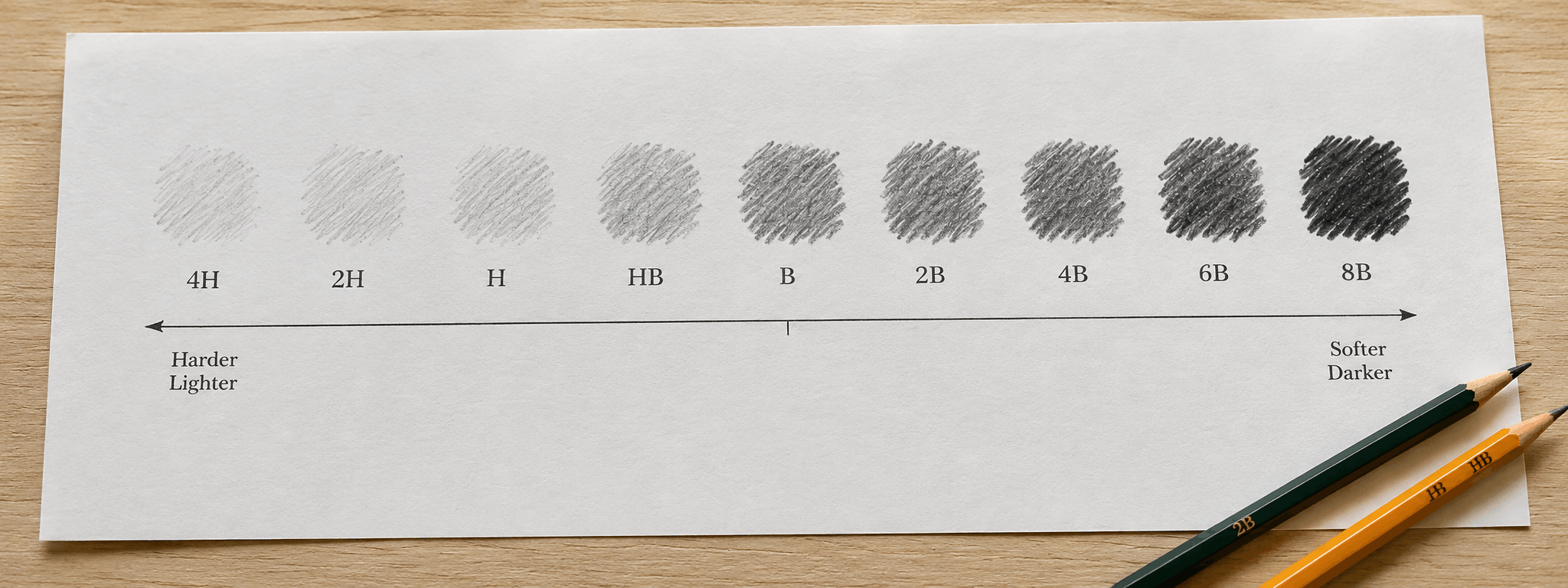
Every pencil grade describes the ratio of graphite to clay inside the lead. More clay makes the lead harder and paler; more graphite makes it softer and darker. The scale runs from 9H (hardest, palest) through F and HB in the middle, down to 9B (softest, darkest).
"H" stands for hard and "B" for black, and HB sits at the balance point between the two, which is where it gets its name. That middle position is exactly why HB became the default grade for handwriting and general-purpose use: dark enough to read comfortably on the page, hard enough that the point holds its shape through a page of notes instead of wearing down or smudging under your hand.
An F grade sits right next to HB on the scale and is sometimes used interchangeably for writing, but HB remains the far more common and widely stocked option in Australia, which is why it's the grade most school lists name specifically.
HB vs 2B vs Mechanical: Which Do You Actually Need?
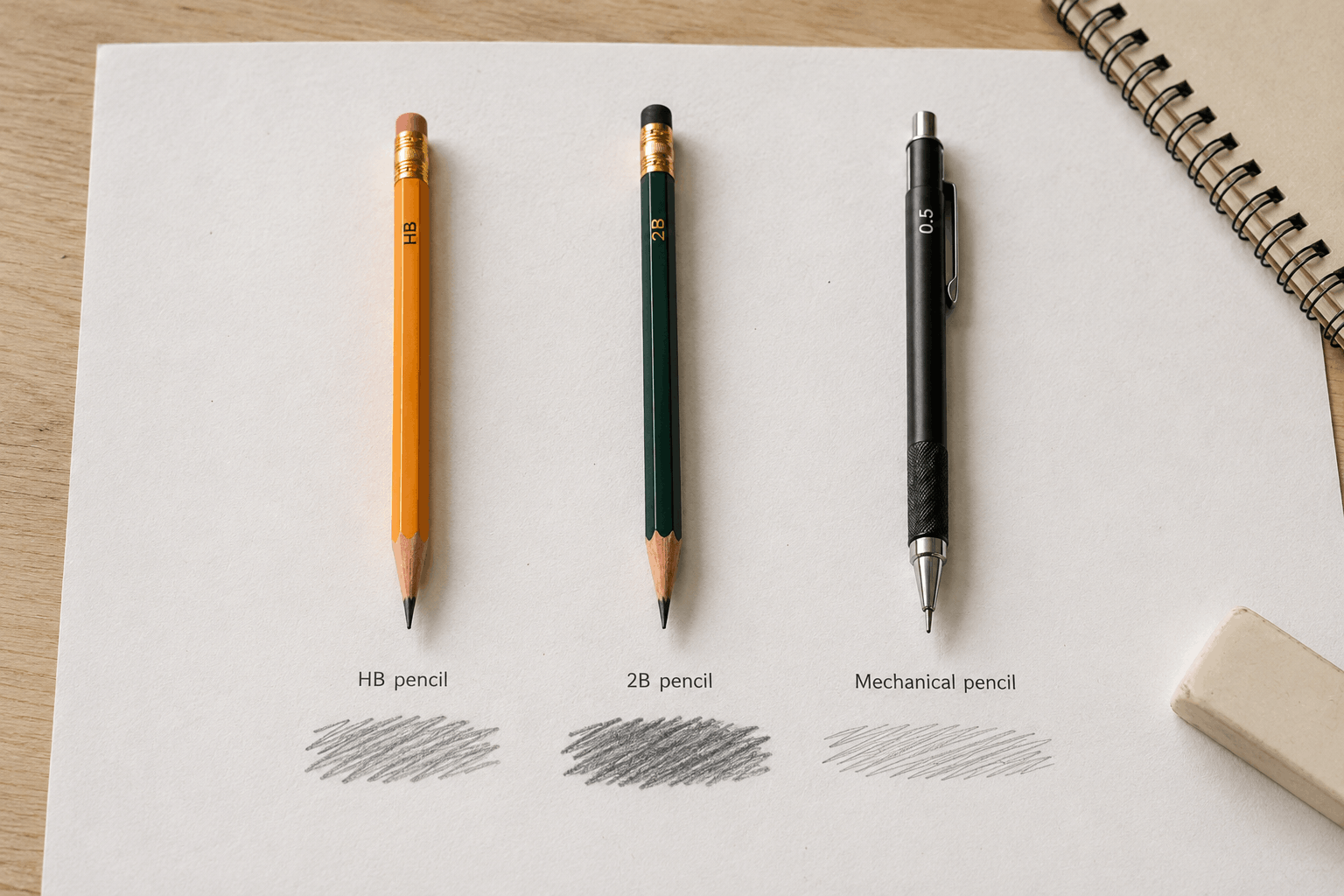
The right choice depends less on the grade name and more on what you're doing with it. For everyday handwriting and note-taking, HB does the job: it stays sharp and won't smudge under a resting hand. Sketching and shading is a different game, since 2B and softer grades lay down tone quickly and blend far more easily. And if convenience matters more than mark quality, a mechanical pencil solves an entirely different problem: it never needs sharpening and keeps a consistent line width from the first page to the last.
| Pencil type | Best for | Sharpening | Common Australian use |
|---|---|---|---|
| HB (wood-cased) | Everyday writing, note-taking, general schoolwork | Regular | Default grade on most school stationery lists |
| 2B (wood-cased) | Sketching, shading, bolder handwriting for younger children | Regular, wears faster than HB | Art classes; some primary school lists for early writers |
| Mechanical (HB lead) | Consistent line width, no lost sharpeners, frequent use | Not required | High school and university note-taking |
If you only remember one rule: match the grade to the task, not the other way around. You can browse Ink Depot's HB and 2B pencil range to compare wood-cased and mechanical options side by side, including well-known ranges like Staedtler Traditional and Mars Lumograph.
Pencils for Australian Schools: What "HB on the List" Really Means
Most Australian state school stationery lists ask for HB pencils as standard equipment, and for everyday classroom writing that's a straightforward requirement: HB is legible, durable and doesn't cost much to keep replacing through a school term. Always check your specific school's list, though, since some primary schools specify 2B for younger children who press harder and benefit from a darker, softer line.
Exam and test conditions get more specific, and this is also where most of the confusion around "HB or 2B" comes from. Paper-based NAPLAN test instructions used to state "use 2B or HB pencil only," and HB wasn't the only grade named for legibility reasons. Darker, softer graphite marks read more reliably on optical scanners than fainter HB marks, so scanner-marked answer sheets tended to favour 2B specifically.
Important: Most NAPLAN tests are now completed online. Check nap.edu.au or your child's school for the current format before assuming any particular pencil grade is required.
A school list can still say "HB pencil" out of habit even after the paper test it once supported has moved online, so it pays not to assume the rule still applies. The safest approach is checking the current format directly through nap.edu.au or your child's school before test season, and treating "HB or 2B" school-list requirements as a starting point rather than a strict rulebook.
Pencils for Sketching and Art Projects
Once you move from writing to drawing, the grade you want shifts further down the B scale. HB can still outline and rough in a sketch, but 2B through 4B give you a much wider tonal range in fewer strokes, useful for shading, building up depth and working quickly without constantly pressing harder to get a darker mark. Softer grades also blend more easily with a finger, tissue or blending stump, which is part of why they're the default recommendation for beginner sketchers.
Barrel shape matters more for comfort than most first-time buyers expect. Hexagonal barrels are the standard, familiar shape; triangular barrels are wider and flatter-sided, and many teachers and occupational therapists recommend them for children who are still developing their pencil grip, since the extra surface area encourages a more relaxed hold. This is general, widely recommended guidance, not a clinically proven fix, so try a triangular barrel without expecting it to solve grip issues on its own.
For anyone who sketches often, a small range of grades (say HB, 2B and 4B) covers most everyday shading needs without committing to a full artist's graphite set aimed at professional illustration work.
Mechanical vs Wood-Cased: A Practical Trade-off, Not a Spec Sheet Choice
The mechanical-versus-wood decision usually comes down to how often the pencil gets used and lost, not price or "which is better." A student who regularly misplaces pencils, forgets a sharpener, or needs a consistent line width for hours of note-taking tends to get more genuine value from a mechanical pencil. An artist or anyone doing varied shading work usually prefers wood-cased pencils across a few grades, since the tactile range and ability to work the point to an angle is harder to replicate with a fixed mechanical tip.
You want a consistent line and no sharpening. It's a common fit for high school and university note-taking.
You want a full tonal range for sketching or shading, or you're following a school list that specifies a wood-cased HB or 2B pencil.
Neither option is objectively better; it comes down to how the pencil will actually be used week to week. If frequent, consistent use is the priority, you can shop mechanical pencils directly.
Caring for Your Pencils (So They Last the Term)
Basic care keeps a pencil usable for longer, and most of it applies across every grade rather than being HB-specific. A sharp, well-maintained point sharpens more evenly and breaks less often than one that's been left blunt and forced through paper. Dropping a pencil, even briefly, can fracture the graphite core inside the wood casing without any visible damage — the pencil looks fine but keeps snapping a few millimetres in every time it's sharpened.
Ink Depot's pencil category page covers the basics of day-to-day care if you want a quick refresher. One thing to keep in mind: softer grades like 2B wear down and need sharpening more often than HB, simply because more graphite is being deposited with every stroke.
See our related guide on safe art supplies for classrooms.
If you just need the short version, here's the fastest way to decide:
- Everyday writing or a standard school list → HB, wood-cased.
- Sketching or shading → 2B or softer.
- Frequent use with no time for sharpening → mechanical pencil, HB lead.
- Exam or NAPLAN → check the current test format before relying on a fixed grade.
Frequently Asked Questions
What's the difference between HB and 2B pencils?
The difference comes down to the graphite-to-clay ratio. HB sits at the balanced midpoint of the hardness scale, giving a light-to-medium line that resists smudging, which suits everyday writing well. 2B has more graphite and less clay, producing a darker, softer line that's better suited to sketching and shading than to fine handwriting.
Do I need an HB or 2B pencil for NAPLAN?
Paper-based NAPLAN tests used to specify "use 2B or HB pencil only," partly because darker 2B marks read more reliably on optical scanners. Most tests are now completed online, so that rule mainly still applies to the paper-based Year 3 writing test. Check nap.edu.au or your child's school for the current format before assuming a fixed grade is required.
Are mechanical pencils allowed at school?
Generally yes, and they're a common choice in high school and university settings. Always check your specific school's stationery list, though, since some primary schools specifically ask for wood-cased HB or 2B pencils rather than mechanical ones.
What pencil grade is best for sketching?
Most beginner sketchers get the most use out of the 2B to 4B range, depending on how dark and soft you want the line to be. HB can still handle light outlining, but softer grades make shading and building up tone much faster.
How many HB pencils does my child need for school?
This varies by school, but stationery lists commonly ask for a multi-pack of around 6 to 12 HB pencils per year, since pencils are easily lost, broken or worn down over a term. Check your school's specific list for an exact quantity.


Any comments?