
Which Printer Has the Cheapest Ink in Australia? Ink Costs Compared for HP, Canon, Epson & Brother

No single brand has the cheapest ink across its whole range. Refillable ink tank printers generally have the lowest ink cost per page of any home inkjet, and all four big names make one: Epson EcoTank, Canon MegaTank, HP Smart Tank and Brother's refillable ink tank models.
With cartridge printers, separate colour cartridges and high-yield (XL) sizes do more for your running cost than the logo does, and being able to use compatible cartridges counts for just as much. Tank printers usually cost more to buy, so they only pay off if you print enough.
Refillable tank printers. You top them up from bottles instead of buying cartridges.
Cartridges with the printhead built in, especially tri-colour ones that get replaced when the first colour runs dry.
Compatible cartridges. If a chip lock blocks them, the cheaper option is gone.
Work out the cost per page for that exact model, then weigh it against the printer's price and how much you print.
Why the ink system matters more than the brand
Each of the four big brands now sells a refillable tank range in Australia, and those tank ranges are what running-cost comparisons tend to favour. On its own, the brand doesn't tell you much.
Inside one brand, a tank model and an entry-level cartridge model can sit further apart on running cost than two rival brands do. Asking whether Epson is cheaper than HP won't get you far. Ask which ink system the printer uses, and whether you can buy cheaper cartridges for it.
What you'll actually spend depends mostly on that ink system, covered in detail below, and on whether you buy standard or high-yield (XL) cartridges. Two other factors can swing it either way. A chip lock can limit you to genuine supplies, and your print volume decides whether a dearer tank printer earns back its price.
How to compare ink costs fairly
Cartridge prices tell you very little on their own. The figure that matters is cost per page, which is the cartridge or bottle price divided by the number of pages it's rated to print. Our guide on how to calculate printing costs walks through the sum, so here we'll stick to the mistakes people make when comparing printers.
Manufacturers rate ink yields on standard test pages (ISO/IEC 24711 for inkjet supplies). Print heavier pages and you'll get fewer of them. A school project packed with colour photos or solid charts gets through ink far faster than a typed letter, so read any rated yield as the best case for light-coverage pages.
For any model on your shortlist, run through these five checks:
- Supply codes: Similar-looking models in the same range can use different supplies, so look up the cartridge or bottle codes for this one.
- Every colour, every size: Add up black plus each colour. If high-yield (XL) versions exist, price those as well.
- Like for like: Genuine against genuine and compatible against compatible, at the same size and current prices.
- Compatibles: Are compatible or remanufactured options listed for this model? On an HP, also find out whether it uses Dynamic Security.
- Volume vs purchase price: Estimate your monthly pages. The more you print, the sooner cheaper ink makes up for a higher purchase price.
CHOICE and other independent testers work out cost per page the same basic way, leaving out ink used in cleaning cycles. It's a fair method for comparing printers. It also means published per-page figures understate real-world costs, and the gap is widest for people who print occasionally.
How the three ink systems differ
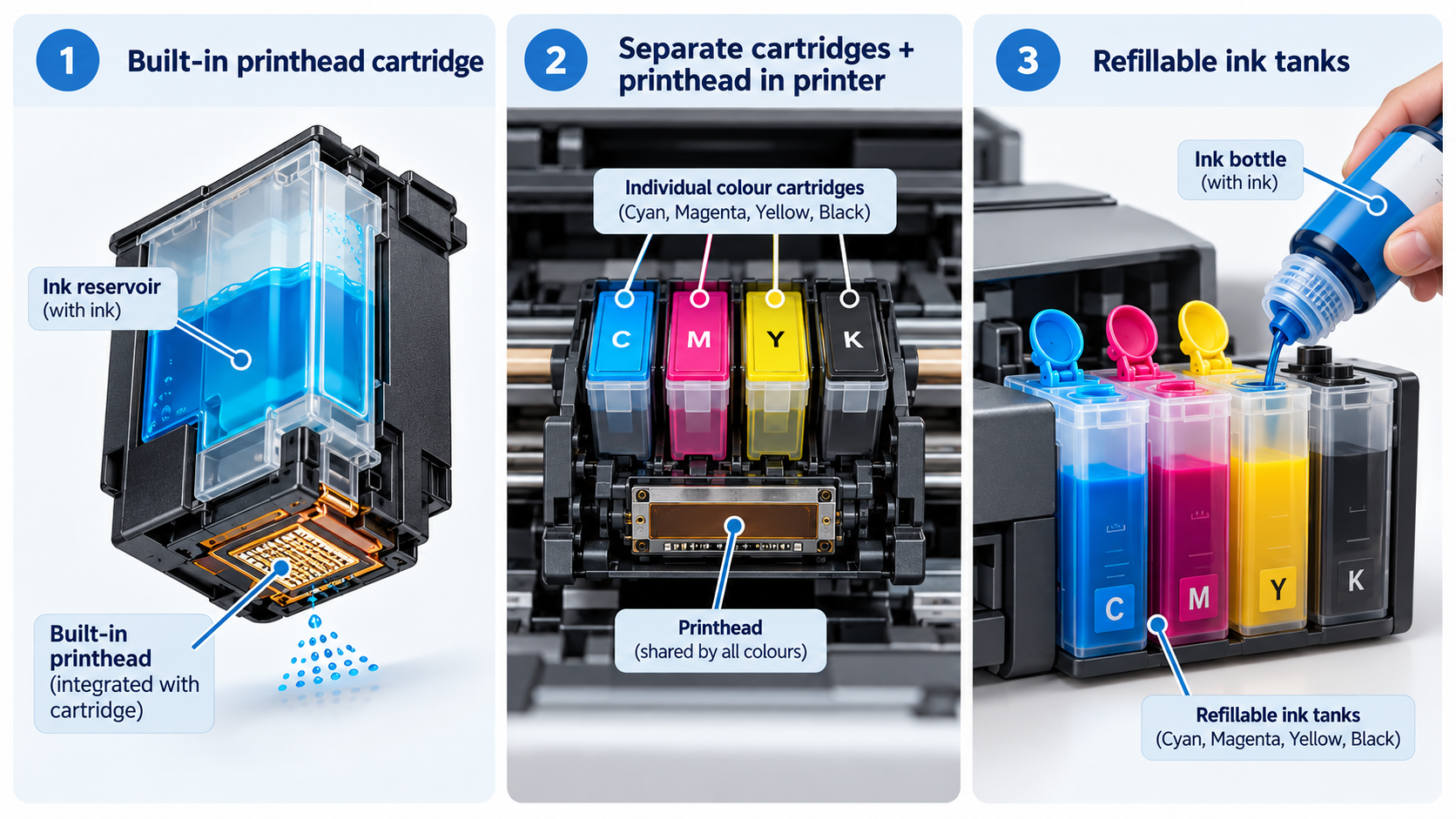
Every home inkjet is built around one of three designs.
Refillable ink tanks
Tank printers have large reservoirs built in, which you top up from bottles, and a single bottle is rated in the thousands of pages. Brother rates its BTD180 bottles at up to 7,500 pages for black and 5,000 pages for each colour. HP lists its HP 31 colour bottles at around 8,000 pages for Smart Tank models such as the 7005. Of all home inkjets, refillable tank models generally have the lowest ink cost per page.
The catch is the printer's price. Tank models usually cost more to buy than entry-level cartridge printers, and whether the ink savings cover the difference depends on your print volume. Our guide to ink tanks vs cartridges works through it by usage type.
Separate colour cartridges
The printhead lives in the printer, and each colour gets its own cartridge. Run out of cyan and cyan is all you replace. Many of these printers take high-yield (XL) cartridges as well, and XL sizes usually cost less per page than standard ones, though run the numbers for your own model before assuming so.
Cartridges with a built-in printhead
In some designs the printhead is part of the cartridge itself, so every replacement buys new printhead hardware along with the ink. HP's DeskJet and ENVY ranges are common examples.
These printers often pair a black cartridge with one tri-colour cartridge holding cyan, magenta and yellow. When any one of the three runs dry, the whole cartridge has to go, with ink still left in the other two chambers. If you print a lot of one colour, say blue headings or a school logo, that wasted ink mounts up.
Not sure which design you've got? The cartridge list for the model gives it away, because one black plus one tri-colour means a combined colour cartridge. For where the printhead sits, look in the printer's manual or on the manufacturer's specification page.
How HP, Canon, Epson and Brother ink costs compare
This table maps each brand's ranges against the ink systems above. There's no ranking, because the cheapest option depends on the model. Ink Depot's range covers genuine and compatible printer cartridges for all four brands, plus refill ink bottles for tank printers.
| Brand | Tank range | What to check on cartridge models |
|---|---|---|
| Epson | EcoTank, refilled from Epson ink bottles | Whether colours are separate and an XL size exists; match the exact cartridge code |
| Canon | MegaTank, including MAXIFY GX models | Whether a PIXMA model takes separate colours or a combined colour cartridge |
| HP | Smart Tank, refilled from HP ink bottles | Built-in-printhead cartridges in DeskJet and ENVY models, and Dynamic Security |
| Brother | Refillable ink tank models such as the DCP-T580DW, using BTD180 bottles | Standard vs high-yield LC cartridges in MFC-J models, compared per page |
Epson
EcoTank is the range people cite most often for low ink costs. It refills from bottles, and if you print regularly, colour especially, it's where an Epson comparison should start. Before ordering bottles or Epson ink cartridges, match the code to your exact model. Epson's cartridge printers get the same scrutiny as anyone else's, starting with whether the colours are separate and a high-yield size exists. After that, price a page at current rates.
Canon
Canon's refillable option is MegaTank, which takes in the MAXIFY GX models and sits alongside EcoTank at the low end of ink cost per page. PIXMA cartridge models vary. Look yours up among our Canon ink cartridges and see whether it takes individual colour cartridges or one combined colour cartridge, since that decides how much ink gets thrown away.
HP
HP covers all three systems. Its Smart Tank printers refill from HP ink bottles, and HP's own Australian buying advice steers light, budget-minded users towards DeskJet and high-volume users towards Smart Tank. DeskJet and ENVY models take cartridges with a built-in printhead, many with a tri-colour cartridge for colour, and that combination explains much of HP's reputation for expensive ink. OfficeJet Pro models deserve their own comparison instead of being lumped in with the entry ranges.
For HP owners, compatibles are the bigger question. Some HP printers use Dynamic Security to block cartridges with non-HP chips or modified circuitry, and HP says periodic firmware updates keep it working. HP's dynamic security page also says cartridges that keep their original HP chip, refilled and remanufactured ones included, are unaffected. Confirm how your model behaves before compatible prices go into any cost comparison. Our HP ink cartridges are listed by printer.
Brother
Brother sells refillable ink tank printers in Australia too. The DCP-T580DW is one, running on BTD180 bottles, and you'll find Brother ink bottles alongside the other brands' refills. On the cartridge side, Brother's MFC-J inkjets use the LC range, high-yield sizes included. Browse Brother ink cartridges by printer model, and when you compare them, price the standard and high-yield versions per page, counting every colour you'll have to replace.
Genuine vs compatible cartridges and chip locks
For many printers, compatible cartridges do more to running cost than anything else, enough to reshuffle the brand comparison. A printer with middling genuine ink prices can turn out cheap to run if reliable compatibles fit it, while a chip lock can strip that advantage from a printer that otherwise looked good value.
Important: If you plan to use compatible cartridges in an HP printer, find out first whether the model has Dynamic Security. The feature can block cartridges with non-HP chips, and a firmware update can change which cartridges the printer accepts.
HP's approach has already drawn regulatory action in Australia. In 2018 the ACCC accepted a court-enforceable undertaking from HP after it failed to disclose that some of its inkjet printers had technology intended to stop them working with non-HP cartridges. Under the undertaking, HP offered compensation to affected owners and agreed to improve messaging about the feature on printer packaging and at point of sale. It also released a firmware update to disable the feature on inkjet printers made before 1 December 2016. The full details are on the ACCC undertakings register. On any HP you're considering, read the packaging and product information for mentions of cartridge security.
Warranty is the other worry that keeps people on genuine cartridges. A compatible won't automatically cost you your rights, although damage caused by a faulty cartridge may not be covered. HP's own position follows that line: a non-HP cartridge leaves its Limited Warranty intact, yet printer or printhead damage attributable to one isn't covered. Your consumer guarantees under the Australian Consumer Law are a separate matter and apply automatically, whatever a manufacturer's warranty says. With other brands, read the warranty terms that came with your model.
Why light printing costs more per page
Print a few pages a month and your true cost per page can land well above any published figure. Part of the reason is maintenance. Inkjets spend ink keeping the printhead nozzles clear, none of which reaches the paper, and spread across a handful of pages it raises the cost of every one. Ink left untouched for long stretches can also dry out before you use it. Our article on why printer ink is so expensive goes into the wider reasons.
Setup cartridges in new printers are often lower-yield than the replacements you'll buy later, so the first set can run out sooner than expected. Some printers ship with fuller supplies. Brother says the bottles in the DCP-T580DW box hold about 95% of a full black bottle's rated yield and 89% for each colour. Look at what's in the box before you compare first-year costs.
Matching an ink system to how much you print
How much you print, and what kind of pages, narrows things down quickly.
| How you print | Compare first | Why |
|---|---|---|
| Regular colour printing (schoolwork, family photos, home office documents) | Refillable ink tank models | Higher volumes give the lower ink cost per page time to offset the higher purchase price. |
| Moderate printing | Cartridge models with separate colours and high-yield sizes | You replace only the colour that runs out, and XL sizes usually cost less per page. |
| Occasional printing | A lower-priced cartridge model, or a mono laser for black documents | At low volumes, a tank printer's higher purchase price takes longer to recover. |
| Mostly black documents | Mono laser printers alongside inkjets' black cost per page | Toner isn't used up by inkjet-style printhead cleaning, so it suits text-heavy printing with long gaps between jobs. |
| Photo-heavy printing | Colour inkjets, model by model | Print quality and colour setup matter as much as ink cost. |
If HP is on your list, look for Dynamic Security before compatible prices sway you. For specific models, our round-up of the best home printers in Australia is a good starting point. The inkjet vs laser printers comparison helps if toner is in the running, or you can browse printers directly. When a cartridge or bottle runs dry, see how to recycle your old cartridges.
Frequently Asked Questions
Is HP ink the most expensive?
Not across the board. DeskJet and ENVY models use cartridges with a built-in printhead, so each replacement includes new printhead hardware, whereas HP Smart Tank models refill from bottles. Some HP printers also use Dynamic Security, which can block cartridges with non-HP chips. Before you count on cheaper compatibles, make sure they'll work in your model.
Do compatible cartridges void my warranty in Australia?
Not automatically, though damage caused by a faulty cartridge may not be covered. HP, for example, keeps its Limited Warranty in place when you use a non-HP cartridge but won't cover printer or printhead damage attributable to one. Your consumer guarantees under the Australian Consumer Law also apply automatically, regardless of any manufacturer's warranty.
Are XL cartridges really cheaper?
Usually, once you measure cost per page instead of cartridge price. XL cartridges cost more up front and are rated for more pages. The gap between standard and XL varies, so divide each size's price by its rated yield for your model.
Why did my new printer's ink run out so fast?
Many new printers come with lower-yield setup cartridges, which run out sooner than the replacements you'll buy later. Some tank printers ship with near-full bottles instead, so look at what's in the box for your model.
Is a laser printer cheaper to run than an inkjet?
For mostly black text it can be, though not always. If black documents are most of what you print, compare a mono laser's toner cost per page with the inkjets on your list, using the same method. For colour and mixed home printing, start with the ink systems covered in this guide.


Any comments?